

Bali’s local food, the way we love to eat it and unique
After eight years of living in Bali, we didn’t think the island could still surprise us. Then a forager in the jungle of Payangan held out a grilled ulat sagu (sago worm) on a stick, stingless bees humming somewhere above our heads and the smell of wild herbs all around us. We ate it, and that bite taught us more about Balinese food than years of restaurant meals ever did.
Bali’s food culture, beyond the restaurants


Bali is famous for its temples and coastline, and lately for its restaurant scene too (our Bali fine dining guide covers the best of it). What doesn’t get enough credit is everything underneath: the pasar malam (night market) that comes alive after dark, the family compounds where recipes have been cooked the same way for generations, and the rice paddies that shape not just the food but the whole spiritual rhythm of Balinese life. For couples willing to look for it, Bali offers something most honeymoon destinations can’t, a truly local food experience rather than a packaged version made for tourists. Below are the ones we’d recommend to a close friend.
Night markets in Bali
There’s a kind of evening in Bali that most visitors never find. It happens at the pasar malam, where locals were gathering after dark long before tourism arrived. These aren’t curated “night markets” designed for visitors. They’re open-air food markets where smoke from charcoal grills mixes with the smell of frying banana and spiced coconut, plastic chairs are pulled up to makeshift tables, and the noise level is cheerfully impossible. One thing to know: a full meal here costs less than a coffee almost anywhere else you’ll eat this week.
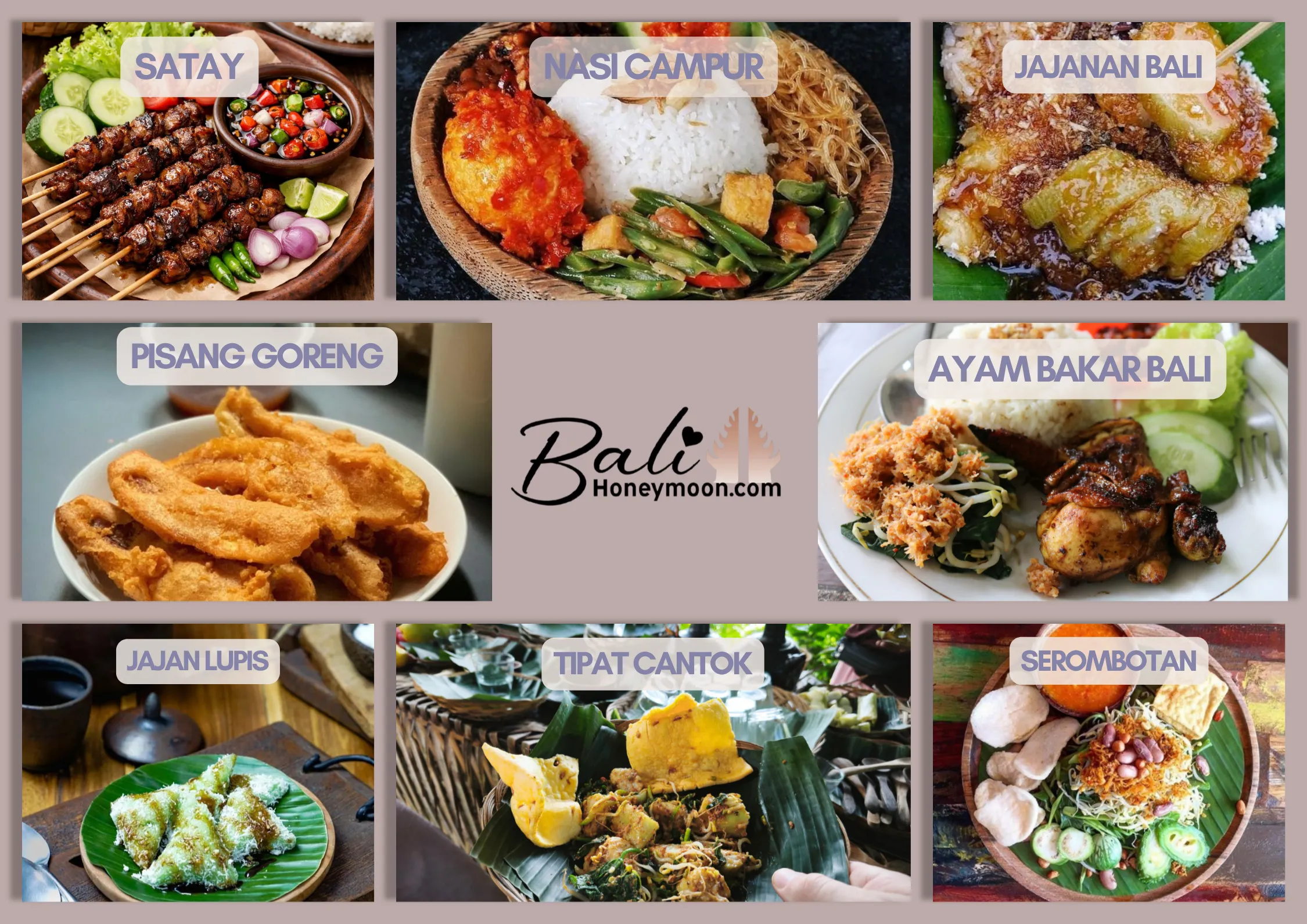
The food is the point. There’s sate (satay) in every variation, from chicken and pork to minced fish wrapped around lemongrass and charred over coconut husks. Nasi campur is simply rice with whatever dishes catch your eye that evening, maybe braised jackfruit, fried tempeh, spiced long beans or a sliver of crispy duck. Ayam bakar is grilled chicken glazed with sweet soy and turmeric. For something sweet, try martabak, a stuffed pancake that comes sweet or savory and is, in our opinion, one of the most underrated street foods in Southeast Asia. And order the pisang goreng (fried banana) while it’s hot, because it’s even better than it sounds. A freshly squeezed juice completes the meal, and you can ask for less sugar or none at all.
For the most local taste, look out for jajan Bali, traditional Balinese snacks in colors that tell you nothing about how they’ll taste. One of our favorites is laklak, small rice flour pancakes served with grated coconut and palm sugar syrup. Another is klepon, a chewy green rice ball filled with liquid palm sugar, so bite carefully or it will squirt. Many of the most luxurious hotels in Bali serve these snacks with afternoon tea, but they taste better at the market.
For couples, an evening at a night market is one of the most authentic and affordable things you can do in Bali. You’re stepping into someone else’s ordinary evening, and that’s a rare thing to experience as a visitor.
Our favorite night markets in Bali
1. Gianyar Night Market (Pasar Senggol Gianyar)
For a lively food night with serious variety, Pasar Senggol Gianyar is our pick. It’s big enough to offer plenty of choice without losing its local character, and it comes alive after 6pm. Foodies drive here from across the island for its crispy babi guling (suckling pig) and rich ayam betutu (slow-cooked spiced chicken).


It’s around 30 minutes by car from Ubud, but check Google Maps before you leave, as traffic gets heavy in the early evening.
2. Kreneng and Badung markets (Denpasar)
Bali’s capital is the place to see Balinese city life up close. Pasar Kreneng has a buzzing street food scene that’s best at night, while Pasar Badung, the big riverside market that runs around the clock, is a sprawling traditional trading center full of local produce and goods, with free entry. Just nearby, the fabric shops along Jalan Sulawesi sell high-quality textiles, great for a souvenir or for having matching outfits tailored for the two of you. Denpasar is a fairly easy trip from Seminyak or Canggu, though the traffic can get serious.


3. Sindhu Night Market (Sanur)
On the south coast, Pasar Malam Sindhu in Sanur is the gentle introduction: clean, organized, tourist-friendly and fairly small, with most vendors speaking some English. It’s an easy first taste of sate ayam and martabak without the city chaos, and a great stop if you get hungry after a beach day, as it’s only a short walk from Sindhu Beach. It opens in the late afternoon and is at its best between 6pm and 7pm, when all the vendors are ready. Like most night markets in Bali, don’t expect anything fancy: plastic stools, flickering lights, motorbikes, the odd street dog, and some of the best Indonesian food you’ll eat for pocket change.


4. Klungkung Market (East Bali)
A good stop on your way back from Padangbai, where the ferries leave for the Gili Islands. Right across from the historic Kerta Gosa, Pasar Tematik Klungkung pulls off a fun plot twist: a street food market with a sleek, restaurant-style makeover that still charges kaki lima (street cart) prices. Forget the cramped, sweaty market stereotype. The revitalized food hall is spacious, spotless and good-looking, and almost untouched by tourism, which makes it an easy date spot for sharing a plate of serombotan, Klungkung’s famous mix of blanched vegetables with fiery peanut sauce and roasted grated coconut.
A quick warning for couples: the spice levels here are not toned down for Western palates. Unless you both have a serious tolerance for Balinese heat, keep some sweet jajan pasar (rice cakes) or a cold drink within reach.


If you’d rather go with someone who knows where to point and what to order, Bali Culinary Tours runs guided night market tours in Gianyar and Denpasar. They take the guesswork out of ordering, help you avoid Bali belly, and lead you to flavors most tourists never find.
Foraging with Locavore NXT
We were convinced we’d seen and tasted most of what Bali had to offer. A day of foraging proved us wrong.
Dinner at Locavore NXT


Locavore NXT is arguably the best fine dining restaurant in Bali, built entirely on local ingredients and served as an immersive experience that takes you from the fermentation lab to the mushroom cellar and the rooftop herb garden. We already knew the restaurant well, famous for its seasonal local produce and careful craft, but we had never joined their foraging trail.

The foraging trail in Buahan and Payangan
The day starts with breakfast at Locavore NXT, and not a standard hotel breakfast but a properly Balinese one: leaf-wrapped sticky rice with cassava, corn and palm sugar inside, a meal that already signals the day will be different. From there you drive north into the Buahan area above Ubud, towards the mountains of Kintamani. The higher you go, the cooler the air and the richer the volcanic soil, and the plants change, so the food changes with them.


A local forager guided us through the farm and the surrounding jungle, where we tasted honey from stingless bees, four kinds of passion fruit, countless herbs, the sago worm, and got a little tipsy on freshly made arak with palm sugar. This isn’t a guide pointing at plants. It’s someone who has spent a lifetime learning Bali’s vegetation and loves sharing it. We saw herbs we’d never come across in all our years here, many of them used as medicine for generations, and even a green leaf with the same tingling aftertaste as the Sichuan pepper in a good hot pot.


The day ended with lunch in the jungle, hosted by the forager’s family (the cook was our guide’s wife). We ate tipat cantok, a local cousin of gado gado made almost entirely from ingredients foraged or grown on site. It was slow and warm, and knowing most of it was picked minutes earlier made it special.
Practical note: book well in advance, as spaces are limited. We strongly recommend having dinner at Locavore NXT the evening before, because the two experiences speak to each other in a way that’s worth planning around.
Cooking classes in Bali
Bali is full of cooking classes, from resort programs like the one at The Menjangan in West Bali to hidden beachside kitchens and village workshops. For your honeymoon, though, you’ll want one that’s run by passionate locals and worth a morning of your trip. These are the classes we’d book.
1. Paon Cooking Class, Ubud


This is our favorite, and we’ve tried several. Paon is run by Puspa, a Balinese woman who turned her umah (traditional family compound) into a cooking school, so you’re a guest in someone’s home rather than a customer at a tourist activity. It starts with a morning market visit to buy the ingredients you’ll actually use. Back in the compound you’ll make sate lilit, urap, Balinese curry, sambal matah, gado gado and pisang goreng in an open-air kitchen. The class isn’t private, so you’ll share the kitchen with a small group of other travelers, but what stays with you is the setting: offerings in the corners and the sounds of a village morning all around.
Booking tip: book ahead. Places are limited, and that’s why it works.
2. Hotel Tugu cooking class, Canggu


If you think Canggu is all trendy beach clubs and loud motorbikes, try the cooking class at Hotel Tugu Bali. Just a minute from Batu Bolong beach, the hotel is a small museum of Indonesian art and culture, an oasis of authenticity surrounded by Canggu’s neon lights. The class is open to outside guests, and the hotel likes to mention it has hosted royalty and presidents, so this is your chance to take over their kitchen. It’s a great choice if you’re staying in Canggu, though it’s a bit more expensive than the other classes here.
3. Anandini farm-to-table cooking class, Sidemen


Sidemen is one of Bali’s most beautiful and least visited valleys, all rice terraces and rivers with Mount Agung on the horizon. Anandini runs a calm, plant-based class there, for vegans and non-vegans who love real local food alike. For couples who’d rather slow down than brave another busy Ubud morning, you’ll harvest organic ingredients together before cooking them. The catch: it’s a long drive if you aren’t staying nearby, and hardcore meat lovers might miss the traditional chicken and fish dishes.
4. Rendang cooking class, Seminyak


This class focuses on a single dish, and it’s one of our favorite Indonesian dishes: rendang, beef slow-cooked in coconut milk and complex spices, originally from the Minangkabau region of West Sumatra (though Malaysians proudly claim it too). It’s one of the most technically demanding recipes in Indonesian cooking, so this is a skill-based class for couples who want to go home able to recreate something extraordinary. It lacks the jungle views and the variety of a multi-dish menu, but that’s the reality of a class in busy Seminyak.
Small tip: many hotels in Bali run cooking classes for their guests, so ask at your hotel before booking elsewhere. It’s often the most convenient option.
Morning markets in Bali
If night markets are where Bali eats, the pasar pagi (morning market) is where Bali shops. This is where locals buy fresh ingredients for the day: vegetables and fruit still carrying soil and dew, bundles of spices, flowers for offerings and live chickens, bought and sold quickly and loudly by people who have come to the same market their whole lives. Our favorite moment so far was watching a couple haggle over the price of a single item together until the seller finally gave in.
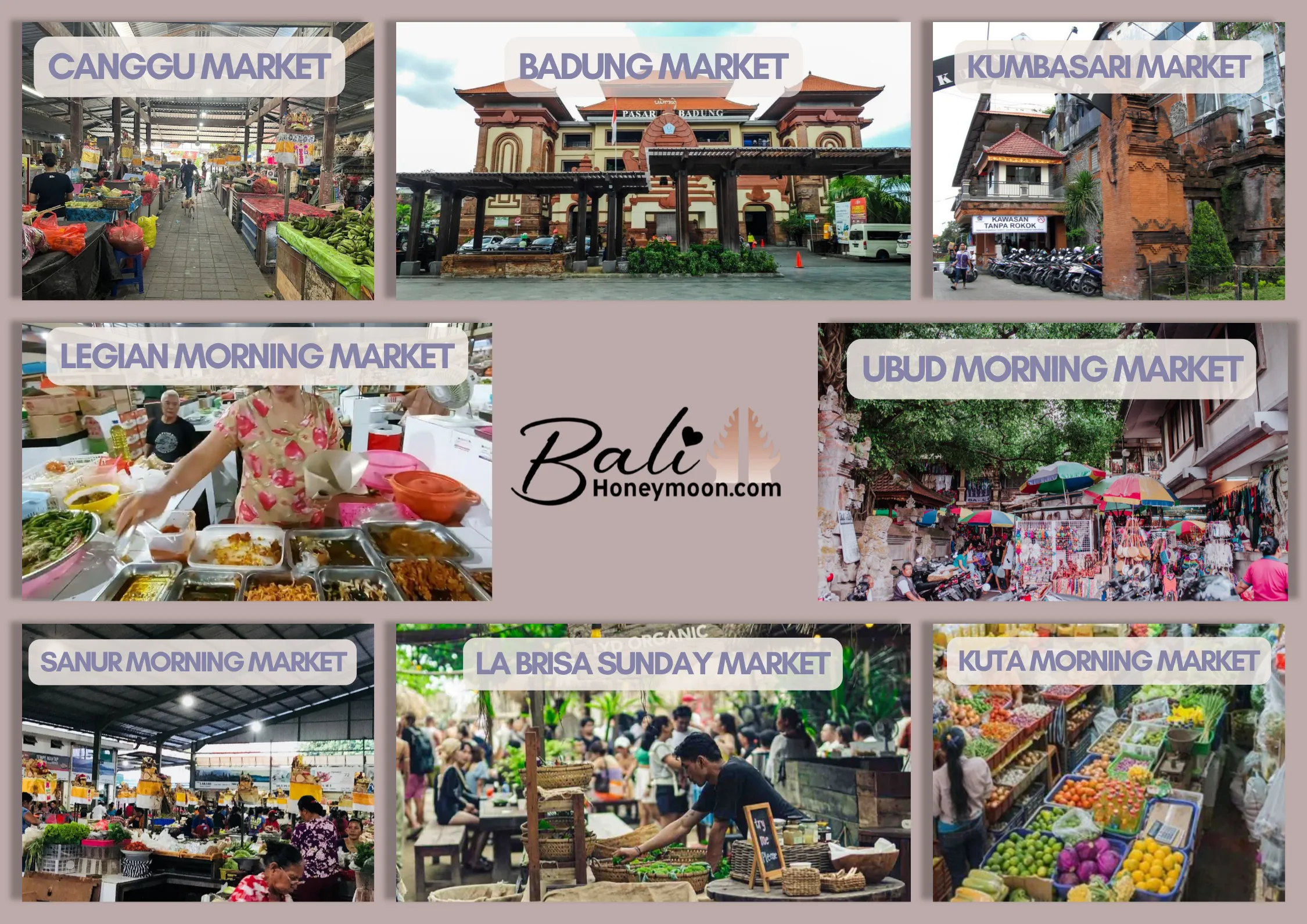
There’s a morning market in every village
Every village has one, so there’s no planning required. Most are done by 8am, when many tourists are still asleep and Bali is already fully awake. For those few hours the island belongs entirely to the Balinese, and wandering through it, even briefly, is the closest you’ll get to seeing what the island really is beneath what it shows visitors. The colors, the scent of incense mixed with tropical fruit and the bargaining in Balinese all around you cost almost nothing, and they stay with you.
A rice farming experience
Fair warning: this one gets your hands dirty, literally. But if one experience in Bali becomes the story couples keep telling long after the honeymoon, it’s this one.
Bali’s relationship with rice isn’t just agricultural, it’s devotional. The subak irrigation system, centuries old and recognized by UNESCO, is both a feat of engineering and a spiritual practice, with water temples setting the planting calendar and the rice cycle shaping festivals, offerings and daily life. Stepping into a paddy together means stepping into something Bali has held sacred for centuries, and there’s something very intimate about two people with their hands in the same soil.
The experience itself is muddy, physical and nothing like a spa day, and that contrast is what makes it special. You’ll work alongside a Balinese farmer, planting or harvesting depending on the season, and come back to your hotel tired, with soil under your fingernails and the particular happiness of having done something real together.
Pemulan Bali farming and firefly night tour, near Ubud


Our recommendation is Pemulan Bali near Ubud, which pairs the rice farming with dinner and a firefly walk in the evening. The combination is almost unfairly romantic: you spend the day grounded in something ancient and earthy, then watch the jungle light up after dark. The firefly part won’t translate into a photo, but it stays with you for a long time.
Sababay Winery, Bali’s own wine
We first walked into Sababay mostly out of curiosity. Wine in Bali? We weren’t expecting much. We stayed for two hours, left with a bottle of their rosé, and have recommended it to nearly every couple we’ve spoken to since.


Sababay Winery has been making wine from Balinese-grown grapes since 2010, and some of it has gone on to win awards. The winery sits in Gianyar along the east coast road from Denpasar, roughly 45 minutes from Ubud or Sanur. A guided tour takes you through the whole process from grape to bottle, followed by a tasting of their range: dry whites, rosés, sparkling and red. The wine isn’t European in character and doesn’t try to be. It tastes like tropical grapes grown in volcanic soil by people who’ve spent more than fifteen years learning to do this properly, and that’s interesting in its own right.

For couples, we’d point you to two experiences. The first is Sip of Love, Sababay’s couples package: a private winery tour followed by a romantic picnic in their tropical garden, with four wines and a chocolate platter made by a local artisan. It’s two unhurried hours for just the two of you, and it’s the one we’d book, which is why it made our list of romantic activities in Bali. The second is Tour and Dine, the same tour but ending with a set menu in the garden, with mains and desserts matched to each wine. It’s better if you’d rather sit at a proper table, or are making a slow afternoon of it and want to arrive hungry.
Short on time, or not sure yet whether Balinese wine is your thing? Wine Down in the Garden is a relaxed tasting of four wines with garden views and no rush, a good way to try before committing to a longer package.
Booking tip: all packages run daily and can be booked directly with Sababay. Reserve at least a day ahead, especially for Sip of Love. The winery is an easy add-on to a day in central Bali, or a calm afternoon after a morning on the Locavore NXT foraging trail.
These are the food experiences we love and still go back to. Choosing the right ones for your honeymoon, the timing, the combination, whether to forage before or after dinner at Locavore NXT, is where we can help. If you’d like a recommendation tailored to the two of you, our honeymoon planning service is made for this.

We are Olivia & Dirk
Hi! We have put together this website with a lot of care, based on our own experiences as well as the experiences of our BaliHoneymoon.com team. As a couple, we have lived in Bali for the past 8 years, and we fell in love with the island. We have visited every corner of Bali, especially the romantic places ;-). While our articles do contain affiliate links, you can trust us to recommend only the experiences that we love.
We can help make your honeymoon perfect:
🧡 Check our Bali honeymoon packages for a stress-free romantic honeymoon.
🧡 Let us design a personalized custom honeymoon itinerary based on your interests.
🧡 Book unique romantic experiences with us.
Read more about BaliHoneymoon.com and our local Bali-based team.
 Instagram
 Tiktok
 Pinterest
 LinkedIn